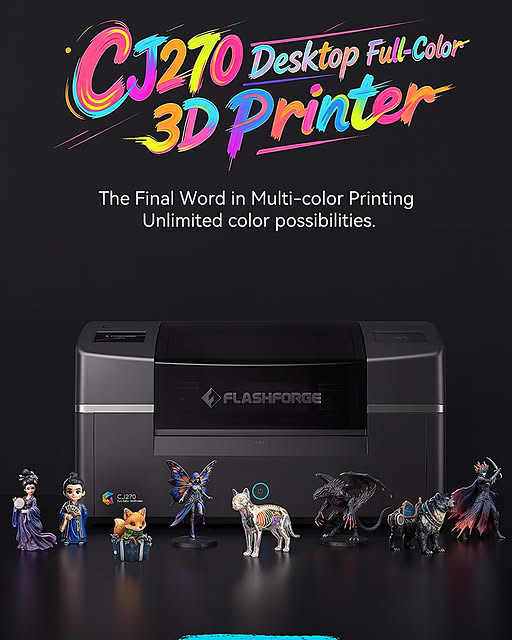
Flashforge CJ270: Full-Color Material Jetting in a Desktop-Sized System
Flashforge is positioning the CJ270 as a compact desktop 3D printer designed for high-resolution color printing. According to the manufacturer, the system supports more than 10 million colors and offers a minimum layer thickness of 7 μm. Flashforge is also promoting an additional €450 early-bird benefit for early customers.
Color 3D Printing in a Compact Desktop System
The Flashforge CJ270 is a compact desktop 3D printer whose main selling point is its approach to full-color printing. According to Flashforge, the system supports more than 10 million colors, potentially providing a much broader color range than conventional FDM/FFF systems that rely on a limited number of separate filament colors.
The CJ270 is aimed at users who want detailed, colorful models while keeping the printer within a desktop-oriented form factor.
7 μm Layer Thickness
One of the printer's highlighted specifications is a minimum layer thickness of 7 μm, equivalent to 0.007 mm.
It is important to note that a manufacturer's minimum layer specification does not mean that every model will be printed at this layer height. Actual results depend on factors such as material, print speed, geometry and slicing parameters.
More Than 10 Million Colors
The most distinctive aspect of the CJ270 is its color capability. Flashforge states that the printer supports more than 10 million colors.
This could be particularly useful for models where a small selection of individual filament colors is not sufficient. A broader color range can potentially enable more detailed decorative models, figures, prototypes and other visually oriented parts.
However, the “10 million+ colors” figure is a manufacturer specification. The number of colors that can actually be reproduced in a physical print depends on the printing technology, materials and specific color-generation process.
Compact Design, Broader Possibilities
A key part of the CJ270 concept is bringing color 3D printing into a desktop-sized machine. This could make the technology interesting for users who do not want to install a larger industrial or professional system but still want more complex visual results than conventional single-color FDM printing can provide.
As with other desktop systems, the compact format can involve trade-offs compared with larger industrial equipment, including build volume, speed or the number of materials that can be handled simultaneously. These factors should be evaluated against the final technical specifications of the CJ270.
€450 Early-Bird Benefit
Flashforge is currently promoting an additional €450 early-bird benefit for CJ270 customers.
Because such offers are normally tied to limited promotional campaigns, customers should check Flashforge's current sales page for the exact eligibility requirements, campaign period and final purchase price.
CJ270 at a Glance
- Compact desktop design
- 7 μm minimum layer thickness, according to the manufacturer's specification
- More than 10 million supported colors, according to Flashforge
- Color 3D printing in a desktop form factor
- €450 early-bird benefit under the current promotion
Conclusion
The Flashforge CJ270 represents an interesting direction for desktop 3D printing by combining a compact form factor with a wide color range and a claimed minimum layer thickness of just 7 μm.
The key question will be how these specifications translate into real-world prints, particularly in terms of color transitions, color accuracy, fine detail and printing speed. Practical testing and the complete technical specification will therefore be important for evaluating the CJ270 beyond its promotional claims.
Why it matters
Full-color material jetting has traditionally been tied to far more expensive industrial systems. The CJ270 is listed at $3,999 in the US, with first shipments planned for October 15, 2026.
Water-soluble supports could be valuable for figurines and visual prototypes.
What remains to be proven?
Color accuracy, consumable cost, printhead maintenance and long-term reliability still need independent testing.